
 |
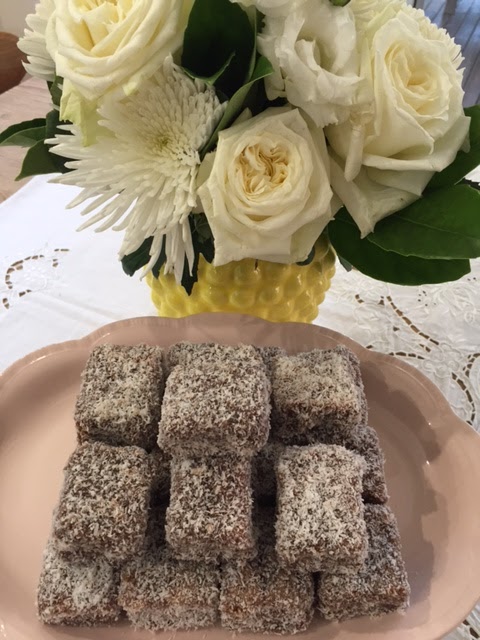
| Classic moist Lamington cakes looking pretty on a vintage pink platter that once belonged to my late grandmother and extraordinary home cook, Baba Joka. |
Finally, my recipe for coconut covered Lamingtons is here! I must apologise for not publishing this sooner. It’s only after receiving requests from readers, family and friends and searching back through my 350 plus posts, that I realised I had not yet included the details on how to make these tasty sweet morsels.
The key to a moist and sturdy Lamington is to bake the cake base the day prior. Once cool, store it in an airtight container until you are ready to coat it with icing and coconut the following day. If you try to dip a fluffy, fresh piece of cake into chocolate icing, it will result in a cascade of crumbs falling into your dipping sauce turning it into a lumpy mess.
I prefer to use desiccated coconut as a coating, but have also successfully tried the shredded and flaked varieties. These are a little more difficult for younger children to swallow s perhaps they are best for teens and adults. Toasting half the coconut flakes in a frypan and mixing them through with un-toasted ones turns classic neighbourhood Lamington cakes into something more sophisticated and worthy of a place as a dinner party dessert option.
Lamingtons
Chocolate Icing Dipping Sauce
Ingredients
100g unsalted butter melted
2/3 cup boiling water
4 tablespoons sifted unsweetened cocoa powder or raw cacao
2 cups icing sugar mixture
Place in a deep bowl and whisk together using a hand balloon whisk until smooth and combined. Set aside until ready to be used for coating the cake pieces.
Don’t forget the coconut…500 g coconut (desiccated, shredded or flaked)
* Food safety: once all of the cake pieces have been coated, discard the coconut and chocolate icing that is left, as these items will contain traces of butter and cake.
Vanilla Sponge Cake
Ingredients
225 g unsalted butter, melted
225 g caster sugar
1 teaspoon vanilla extract
4 large eggs
200 g self raising flour
25g cornflour
1 teaspoon baking powder
2 tablespoons milk
Preheat the oven to 180 degrees on a conventional setting. Grease your tin with butter and line the base and sides with baking paper. I used a square 23 cm spring-form tin with a depth of 8 cm.
Put the butter, sugar, vanilla and eggs into a deep mixing bowl and whisk using either a free standing mixer like a KitchenAid, or hand held electric beaters, until completely smooth and combined. TIP – I always break each egg into a cup, then add it to the mixing bowl just in case the shell disintegrates or there is something not quite right with the egg. It rarely happens but I prefer to take precautions rather than waste the entire batter.
Add the remaining ingredients and whisk again for about 3 minutes until combined. I like to scrape down the mixture with a spatula from the edges of the bowl part way, to ensure the batter is thoroughly mixed through.
Scrape the batter into your prepared tin and smooth to the edges. Place in the oven and bake for 40 – 45 minutes until the cake comes away from the sides of the tin, the top is golden and it springs back to the touch.
Leave to cool in the tin for at least 10 minutes, before turning out onto a cake rack to cool completely. Store in a container in the fridge until you are ready to coat it with icing and coconut the next day.
The cake needs to be cut into even pieces. I made 20 individual Lamingtons. You may prefer a smaller bite sized portion, in which case divide the cake into 30 pieces. Or, for abundantly appealing Lamingtons, bulk up the size and cut into 12 hefty squares.
For extra “wow” factor, Lamingtons can also be sandwiched together with jam and whipped cream, before they are dipped in the chocolate icing and coated with coconut.
Comments are closed here.